How Can AI Improve Quality Control in Narrow-Web Label Printing?
 PPDS
AI-powered optical inspection helps label converters detect printing defects, simplify inspection setup and improve production quality management. INNVESTIO integrates advanced inspection technologies into complete industrial printing workflows.
What is AI-powered optical inspection in label printing?
AI-powered optical inspection combines industrial cameras, image-processing algorithms and artificial intelligence to identify printing defects and analyse production quality.
For narrow-web label manufacturers, these technologies can help identify missing print, damaged characters, registration problems and other defects while reducing unnecessary alarms caused by normal material movement.
INNVESTIO helps printing and packaging manufacturers integrate these capabilities into their production processes, connecting printing equipment, inspection systems, production data and finishing operations.
One of the technologies available through INNVESTIO is LUSTER's Vision+AI approach, including VisionPrint 8 software and the LabelHERO narrow-web inspection portfolio.
Why is quality inspection challenging in narrow-web printing?
Narrow-web printing requires a balance between productivity, precision and flexibility.
Label converters frequently handle short production runs, multiple designs, frequent job changes and demanding quality requirements.
Typical challenges include:
Small printing defects that are difficult to recognise consistently
Missing or damaged text and graphics
Colour and registration variations
Barcode and variable-data errors
Unnecessary inspection alarms
Time-consuming job setup
Defects discovered too late in the production process
Traditional optical inspection systems address many of these problems, but their effectiveness can still depend on operator experience, inspection settings and the ability to distinguish genuine defects from acceptable production variations.
The opportunity is not simply to inspect more material. It is to make inspection more intelligent and better integrated into production.
How does artificial intelligence improve print inspection?
1. Faster and more consistent job setup
Frequent changeovers can make inspection setup a significant operational task.
AI-supported inspection software can help identify relevant inspection parameters and image areas automatically.
LUSTER's VisionPrint 8 technology, for example, provides intelligent recognition capabilities for repeat length, registration marks, inspection boundaries, text areas and variable-data regions.
This reduces repetitive manual configuration and helps establish more consistent inspection conditions between jobs.
2. More intelligent defect detection
Optical inspection systems analyse printed material and identify deviations that may indicate production defects.
AI-supported processing can help improve the recognition and assessment of fine printing defects, including missing characters, small printing omissions and continuous defects.
The appropriate inspection sensitivity depends on the equipment configuration, substrate, printing process and production speed.
3. Fewer unnecessary inspection alarms
Not every image difference represents an unacceptable printing defect.
Web movement, registration variation and changes in material tension can produce differences between captured images and inspection references.
AI-assisted processing can help distinguish these variations from relevant printing defects.
The result is the potential for fewer unnecessary interruptions and more useful defect information for operators.
4. More consistent quality decisions
Inspection becomes more valuable when the information generated can support production decisions.
AI-supported defect classification, quality grading and production data analysis can help quality managers evaluate inspection results using more consistent criteria.
Rather than relying exclusively on individual judgement, manufacturers can develop more repeatable quality assessment practices.
Can AI inspection reduce waste in label production?
AI-supported inspection can contribute to waste reduction by identifying defects earlier and helping production teams understand where defective material occurs.
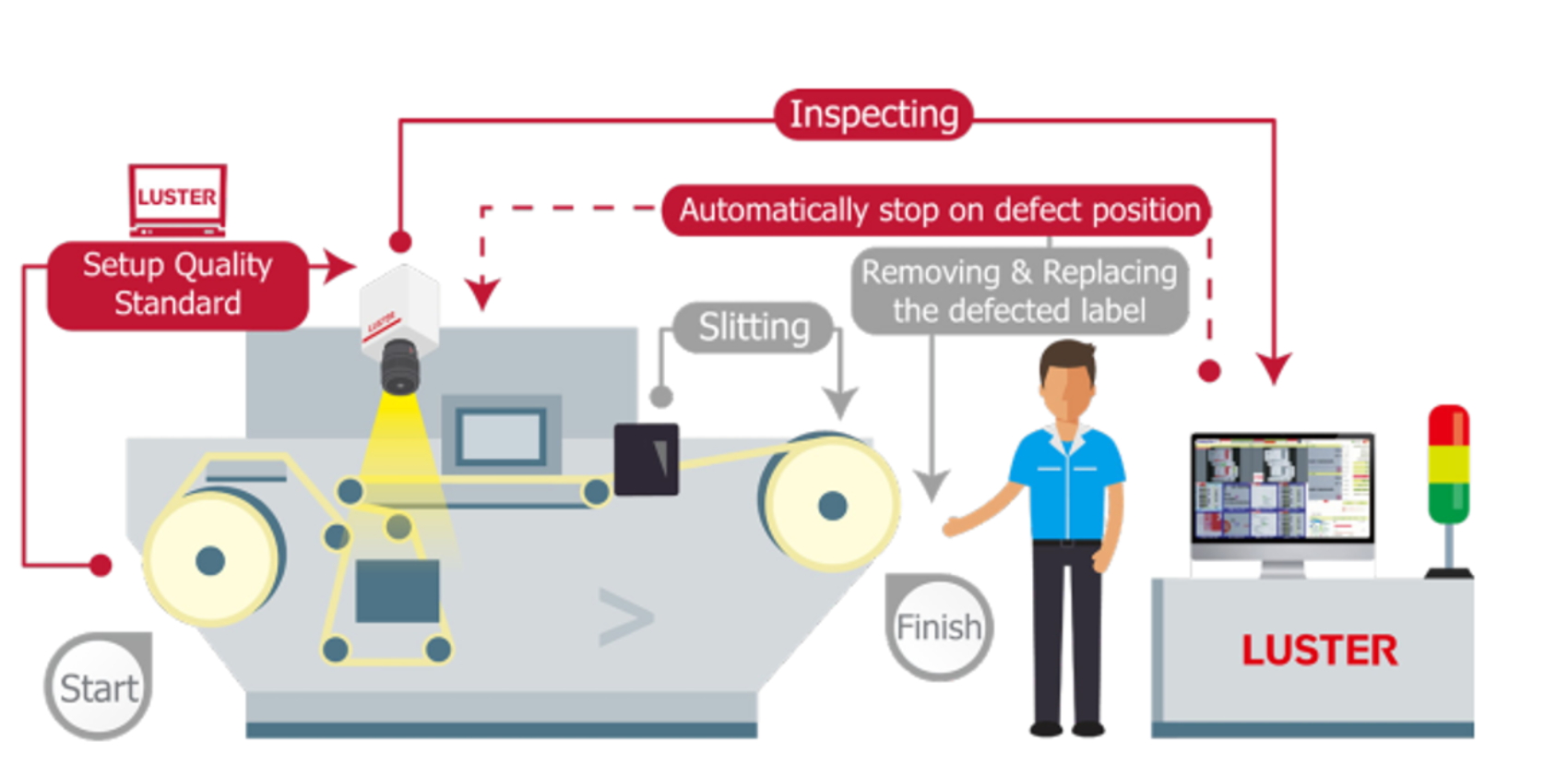
When inspection information is connected to downstream finishing equipment, operators can use defect records to support inspection, rewinding and removal decisions.
This creates opportunities to reduce unnecessary reprinting, avoid excessive overproduction and improve the consistency of finished rolls.
The actual savings depend on the production process, frequency of defects, integration architecture and operational practices. They should be measured against each manufacturer's existing production performance.
How does INNVESTIO integrate optical inspection into production?
INNVESTIO approaches print quality as part of the entire industrial production architecture.
A complete solution may involve:
Inline inspection: Monitoring printed material during production to identify defects and generate inspection records.
Intelligent quality analysis: Classifying defects, analysing inspection information and supporting quality decisions.
Workflow integration: Connecting inspection data with production processes and downstream equipment.
Final-roll verification: Supporting inspection and finishing operations before products are delivered to customers.
Within this architecture, LUSTER provides relevant technologies:
LabelHERO — Optical inspection solutions designed for narrow-web label printing.
VisionPrint 8 — AI-supported software for inspection setup, defect analysis and quality management.
Workflow-R — Inspection-data workflow functionality connecting printing inspection with downstream defect management.
LabelTANK — Equipment for label-roll inspection and rewinding.
The precise combination depends on each converter's machinery, production requirements and technical configuration.
Which industries can benefit from AI-supported label inspection?
The technology is relevant to manufacturers producing labels for food and beverages, cosmetics, personal care, pharmaceuticals, household products and other applications requiring consistent printed information.
Particularly relevant requirements include small text, detailed graphics, brand consistency, barcodes, variable data and production traceability.
AI-supported inspection does not automatically establish regulatory compliance. Where label content or code verification is critical, the required checks must be defined, validated and integrated into the quality management process.
Frequently asked questions
What is the difference between conventional optical inspection and AI-powered inspection?
Conventional optical inspection primarily uses imaging and predefined analysis rules to identify deviations. AI-supported inspection adds learned recognition, classification or decision-support capabilities, depending on the system.
Can AI inspection detect missing text and barcode problems?
Appropriately configured systems can identify missing or damaged text and support code-related inspection. Specific barcode verification capabilities and standards compliance depend on the installed modules and configuration.
Can existing narrow-web printing presses use AI-powered inspection?
Some systems can be integrated into existing production lines. Compatibility depends on press layout, available installation space, speed, substrate, interfaces and downstream equipment.
Does AI replace the printing operator?
No. AI-supported inspection is intended to assist operators and quality managers by reducing repetitive tasks and providing more consistent information. Human oversight and production-specific quality standards remain essential.
Can optical inspection help reduce production waste?
Yes, potentially. Earlier defect detection, more useful inspection information and integration with downstream finishing can help manufacturers manage defective material more effectively. Actual improvements must be verified through production data.
How can a label converter select the right inspection system?
The selection should consider printing technology, web width, operating speed, substrates, typical defects, inspection requirements, data integration and finishing workflow.
INNVESTIO evaluates these factors to help define an appropriate industrial solution.
INNVESTIO | Your partner for intelligent printing quality
Industrial quality does not begin and end with an inspection camera.
It requires the right combination of machinery, process knowledge, inspection technology, data integration and technical support.
As THE INDUSTRIAL ARCHITECT, INNVESTIO helps printing and packaging manufacturers evaluate and integrate technologies that address real production challenges.
Our approach is technology-driven, application-focused and designed around the complete production process.
Want to improve quality control in your narrow-web printing operation?
INNVESTIO | THE INDUSTRIAL ARCHITECT
Contact INNVESTIO to discuss your label applications, inspection challenges and suitable LUSTER solutions https://www.innvestio-group.com/en/#contact .